
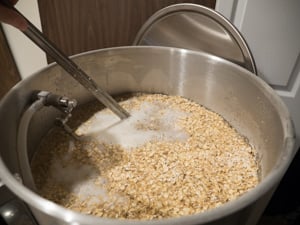
This week I take a look at infusion mashing, an method for managing your mash step temperatures during the mash phase of an all-grain brewing session.
Mashing for All Grain Brewers
The majority of home and professional brewers use an all-grain method for brewing where they start with malted barley grains, and go through phases for the mashing, sparging, boiling, cooling and fermenting the wort into beer. During the mash phase, the crushed malted grains are mixed with water and heated up to a target temperature typically between 146-158F (63-70 C) where enzymes natural to the grain act to break longer starch chains into simple sugars like maltose that can easily be fermented by yeast later in the process. Depending on how modified the malt is and the conditions in the mash this process can take anywhere from 20 minutes to over an hour.
Some brewers have historically used a multi-step mash with a timed rest at different temperatures to achieve additional effects. For example the Lager (German) mash profile is widely used with many European lager styles. It uses a two step mash with the first step in the mid-140’s F (63 C) and the second step in the 159 F (70 C) temperature range. Hitting both steps results in a beer that achieves high fermentability due to the enzymes activated, but still retains good mouthfeel. There are a variety of other multi-step profiles historically used with undermodified malts, but these have largely fallen out of favor with modern brewers who prefer the simplicity and time savings of a single-step mash, occasionally varying into a two step German/Lager mash described above for certain styles.
The Infusion Mashing Method
For the initial infusion mash step, most brewers will target a given water/grain ratio to determine the volume of water to use in the mash. For conventional mashing this water/grain ratio is typically in the 1.25-2 quarts/lb range. For brew-in-a-bag and all-in-one systems often the total water needed for the batch is included up front, resulting in much higher water/grain ratios. Some traditional decoction mash profiles also use high water/grain ratios in the 3-4 qt/lb range.
For a given amount of mash water and grains, it is fairly easy to find the equation for infusion estimates which is based on the specific heat of water, specific heat of grains and the relative volumes and temperature differential. However in practice most brewer use an online calculator or software such as BeerSmith to get the temperature and then just heat their water to that target temperature before mashing in. Once you have the temperature you just heat your water up to that value and then mix in the malts.
Mashing Methods – Achieving Your Target Temperature
Once you have established whether you want to use a single-step or multi-step mash the next decision to make is how to achieve the target temperature for each step. There are three general methods we can apply:
- Infusion Mashing – Water is heated either in the main vessel or a secondary hot liquor tun to a target temperature. For the first step, we usually add the water first and then “dough-in” the grains to achieve the target temperature. In later steps, more hot water can be added to raise the overall temperature, or you can use direct heating or a decoction step.
- Direct Heating – Some mash tuns can be directly heated. We can apply heat to the water before mashing in to do an initial infusion step as described above, and then apply more heat if we need to raise the temperature for subsequent steps. This is often called a “temperature step” as we change the temperature without adding more water.
- Decoction – In a decoction mash step, the first step is typically done as an infusion step mentioned above. However when we need to raise the temperature of the mash for subsquent steps, we actually “decoct” a portion of the water-grain mixture and put it in a separate boil vessel. That portion is heated to boiling and then added back into the main mixture to raise the overall temperature of the mash to our target step temperature. Again, software like BeerSmith is often used to calculate the portion we need to decoct.
Why Infusion Mashing is So Important
Every mash processes start with an infusion mash step. Mash water is measured out and heated and then the grain is added as part of the “dough-in” or “mash-in” to achieve the first mash step. Whether the initial mash water is heated in a separate vessel or in the mash tun itself, it is usually transferred to the mash tun before adding the malts. This is true even for complex multi-step mashes that later use decoction or direct heating to achieve the temperature needed for later mash steps. Therefore, every mash profile starts with an infusion step.
Infusion mashing is important also because it gives the brewer good control and repeatable results when mashing. For a given grain weight you can easily calculate the infusion temperature and volume needed to achieve a step temperature. The only variable is the heat absorbed and lost to the mash tun itself, but in most cases this can be estimated accurately as well.
Today’s popular Brew-in-a-bag and All-in-one brewing systems use an infusion step for the mash-in and then raise the temperature after that with direct heating. So you measure your water and heat it in the all-in-one or pot, then dough-in the grains. If you want to add more mash steps you can then apply direct heat.
Direct heating is also accurate, but an infusion step still needs to be calculated for the initial mash in. Decoction tends to give you less control over the precise step temperatures as it is hard to account for variations in mash thickness pulled for the decoction. Also a decoction generally starts with an infusion step.
I hope you enjoyed this week’s article on infusion mashing. Thanks for joining me on the BeerSmith Home Brewing Blog. If you want to take the guesswork out of brewing, please try my BeerSmith 4 recipe software from BeerSmith.com. Be sure to sign up for my newsletter or my podcast (also on itunes and youtube) for more great tips on homebrewing.


