

This week I take a look at beer color, how it is measured, where it comes from and how color plays a major role in your beer brewing.
The History of Beer Color and Its Measurement
As an interesting side note, a large portion of historic beers were very likely dark or even deep brown, as the majority of malts were historically dried over wood until the invention of coke fired kilns in the 1700’s. The lighter colored pilsners, pales, and IPAs are a fairly recent invention.
The first system to measure and characterize beer color was created by J.W. Lovibond in 1883 and bears his name. The Lovibond system used a series of colored slides or glass standards that were compared to beer color to determine the Lovibond color in “degrees Lovibond. This coloring system is still in wide use for measuring malt color, particularly in the USA. The lovibond scale is show in the malt color wheel image below.
In 1950 the American Society of Brewing Chemists adopted the Standard Reference Method (SRM) system for measuring beer color. In this system, a device is used to measure the attenuation of light at 430 nm passing through a couvette containing 1 cm of beer, and then scaling it by a constant value of 12.7. This system was picked to approximately match the old Lovibond scale, so the two scales are roughly equivalent.
Later the European Brewery Convention (EBC) established a separate scale that also measures the absorbance of light with a 430 nm beam in a 1 cm vial, but it uses a constant of 25. Because of this you can easily convert from SRM to EBC using an approximation of 2 or for a more precise result:
EBC =1.97 * SRM
SRM = EBC/1.97
The SRM and EBC scales have largely replaced Lovibond with the exception of malt color which is often still expressed in Lovibond. Since all of the systems above measure color as a single number, they can’t really capture the full spectrum of beer color possibilities. If we think of the simple Red-Green-Blue-Alpha system to simulate colors on a computer screen it requires at least four dimensions. As a result these scales can’t really capture the subtle red color of an Irish Red Ale or berry, orange or red color of a fruit beer.
Where Beer Color Comes From
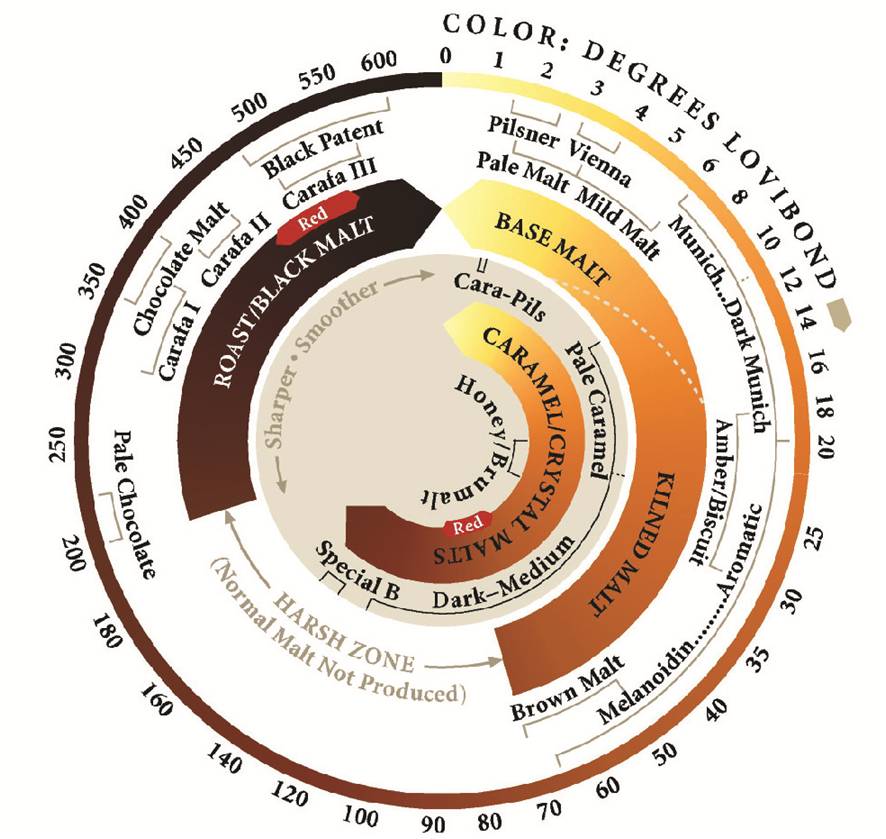
The vast majority of the color in our beer comes directly from the malts used. Darker malts lead to darker beer. Randy Mosher has captured the malt wheel to the right which shows malt color in degrees lovibond for the four major malt groups. Also you can easily estimate the color of a finished beer using software like my BeerSmith brewing software or a the Morey formula covered here.
The vast majority of malt used in brewing is base malt which is the palest of malts, with colors for most base malts in the 2-6 lovibond range. Next we have the kilned malts which are kilned at a higher temperature for a longer period than base malt which results in a darker finish. These malts are darkened by the maillard reaction which is similar to the reaction that darkens bread when you toast it or other foods when you cook them.
Caramel and Crystal malts are made in a slightly different way, but provide a similar color range to kilned malts. These malts are kilned wet which results in a slightly different caramelization reaction that darkens the malt via maillard reactions but also leaves residual sweetness from the crystalized sugars inside the grain.
The darkest malt group is the roast/black malt group. These malts are roasted which actually relies on a different chemical process called pyrolysis which as the name implies is basically a burning process that takes place at high temperature. I did a podcast episode with Randy Mosher discussing malt kilning and maillard reactions here if you want to learn more.
Relating Beer Color to Flavor
There is no strict guide that ties beer color to a given flavor. If you are creative you can create a fairly dark colored beer that tastes exactly like a pale ale or a beer that is light in color and tastes like a stout. However, in general, darker beers tend to contain more kilned, dark crystal or roast malts which creates the flavors we associate with brown ales, porters and stouts. Similarly lighter colored beers lack a lot of the toasted or roasted hints and instead highlight a clean hoppy or pale finish we associate with lagers, IPAs and ales.
However the actual flavors the various malt groups provide is quite varied. A similarly colored brown and dark crystal malt do not have the same flavor profile, so the same beer made from both will not have the same flavor even if the color is the same. If you want a good starting point to understand the flavors that are associated with the major malt groups I recommend you start with this article as well as the individual articles on each malt group linked into this article. Understanding the flavors that individual malts provide to the whole can really help you develop as a beer designer and brewer.
I hope you enjoyed this week’s article on the color of beer and malts. Thanks for joining me on the BeerSmith Home Brewing Blog. If you want to take the guesswork out of brewing, please try my BeerSmith 4 recipe software from BeerSmith.com. Be sure to sign up for my newsletter or my podcast (also on itunes and youtube) for more great tips on homebrewing.


